

Trip Prep
Cruise Travel Insurance: Do You Actually Need It?
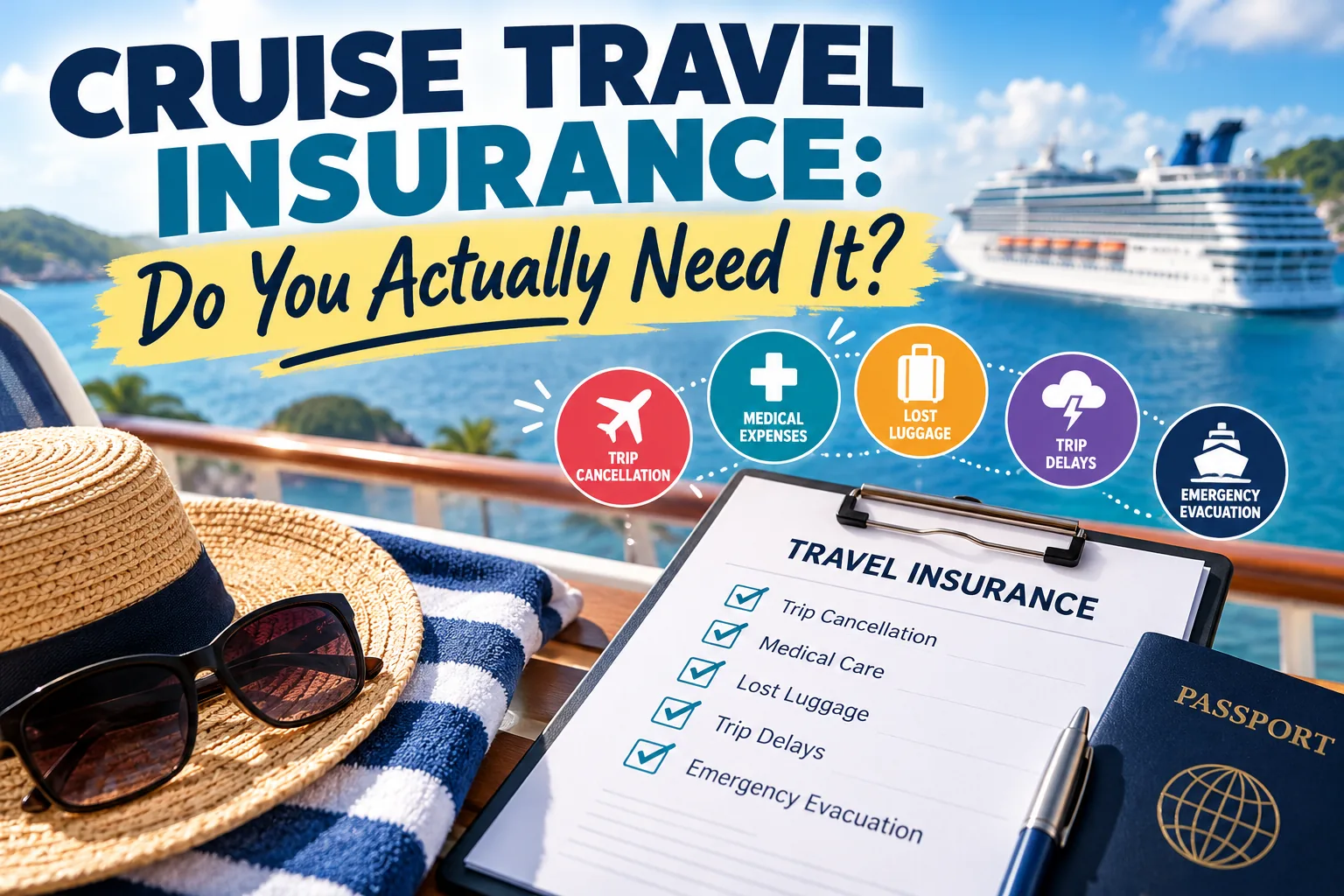
Somewhere between picking your cabin and paying your deposit, the booking screen asks if you'd like to add travel protection. It's a few hundred dollars, it's easy to click "no," and most cruises go off without a hitch. So do you actually need it?
For most cruisers, yes, but probably not the plan that's being offered to you at checkout. Below is what cruise insurance really covers, why a cruise is riskier to go uninsured than a land trip, how the cruise lines' own plans compare with third-party policies, and the short list of travelers who can reasonably skip it.
Why a Cruise Is Different From Other Trips
On a land vacation, if you get sick you go to a hospital. On a cruise, you're on a floating town with a small medical center, and often hours or days from the nearest port. Three things make that expensive:
- Your health insurance may not follow you. Many U.S. health plans offer limited or no coverage outside the country, and the ship's medical center usually wants payment on the spot. You pay first and file for reimbursement later, if your plan pays at all.
- Medicare mostly stops at sea. Original Medicare only covers care on a ship that's in a U.S. port, in U.S. territorial waters, or within six hours of a U.S. port. Beyond that, it generally won't pay, even for a true emergency. Part D generally won't cover prescriptions bought at sea or abroad either.
- Getting you off the ship costs a fortune. If the onboard doctor can't treat you, you may be put ashore in a port with limited care, then flown home. An air ambulance from the Caribbean to Florida runs around $20,000, and longer evacuations can reach $200,000 or more without coverage.
Add the fact that most cruise fares become largely or fully non-refundable once final payment is due (typically 75 to 120 days before sailing on mainstream lines, and earlier for longer voyages), and you have a trip where a lot of money is at risk before you ever leave home.
What Cruise Travel Insurance Actually Covers
A good cruise policy bundles several protections. These are the ones that matter most, in rough order of importance:
- Emergency medical: pays for doctor visits, treatment and hospital care during the trip, including the ship's medical center.
- Medical evacuation: pays to move you to an appropriate hospital, and often home. This is the coverage that prevents a five- or six-figure bill.
- Trip cancellation: refunds your prepaid, non-refundable costs if you cancel for a covered reason, such as illness, injury, or a death in the family.
- Trip interruption: reimburses the unused part of the trip and the cost of getting home if you have to leave early for a covered reason.
- Missed connection and travel delay: helps you catch up to the ship if a flight delay makes you miss embarkation, and covers hotels and meals while you wait. Ships don't wait for late passengers.
- Baggage loss and delay: covers essentials if your luggage doesn't make it to the ship, and replacement costs if it's lost for good.
Cruise Line Plans vs. Third-Party Insurance
Every major line sells its own protection plan, and it's the convenient choice: one click, added to your booking. But convenience is about all it has going for it in most cases. Here's how two of the most popular cruise line plans compare with a couple of third-party cruise policies, based on mid-2026 comparisons from Squaremouth:
| Plan | Typical cost | Emergency medical | Medical evacuation | Cancel for any reason |
|---|---|---|---|---|
| Carnival Vacation Protection | 5%–18% of cruise fare | $20,000, shared by everyone on the booking | $50,000 total | 75% back, as a future cruise credit |
| Royal Caribbean Travel Protection | 8%–10% of cruise fare | $100,000 (secondary) | Up to $500,000 | 90% back, as a cruise credit |
| IMG iTravelInsured Choice Cruise | ~4% of total trip cost | $100,000 per person (primary) | $500,000 per person | Not offered |
| Seven Corners Cruise | ~6% of total trip cost | $250,000 per person (secondary) | $500,000 per person | Optional, 75% back in cash |
The third-party prices above are from a sample quote for two 55-year-olds on a $9,000 trip: about $397 for the IMG plan and $498 for Seven Corners. Third-party cruise plans generally run 4% to 10% of trip cost, averaging around 6%, and the price rises with age. Cruise line plans are usually priced on the cruise fare alone and aren't age-rated, which can make them competitive for travelers in their 70s and 80s. They're also expensive on short, cheap sailings, where Carnival's plan can run 18% of the fare.
Four differences matter more than price:
- Medical limits. Carnival's $20,000 medical limit is shared across your whole reservation. One serious illness for one person can use it up. A common rule of thumb is at least $50,000 in medical and $100,000 in evacuation coverage per person, and more for remote itineraries like Alaska, Antarctica, or long ocean crossings.
- Credits vs. cash. Cruise line "cancel for any reason" benefits typically pay you back in future cruise credit, which can expire, carries blackout dates, and only works with that line. Third-party plans pay claims in cash.
- What's covered. Cruise line plans focus on the cruise itself. Third-party plans can cover your flights, pre-cruise hotel, and excursions you booked elsewhere, all on one policy.
- Who it protects. If the cruise line itself has a problem, a policy from an independent insurer is on your side, not the line's.
"Cancel for Any Reason": Worth the Upgrade?
Standard cancellation coverage only pays for listed reasons, such as illness, injury, a family emergency, or a hurricane that hits your home. Changed your mind, have a work conflict, or just don't feel like going? That's not covered. Cancel for Any Reason (CFAR) fixes that, for a price.
On third-party plans, CFAR is an add-on that usually raises your premium by around 40% to 60% and reimburses 50% to 75% of your non-refundable costs. The rules are strict and vary by insurer, but typically you must buy the policy within 14 to 21 days of your first trip payment, insure the full non-refundable cost of the trip, and cancel at least two days before departure. Miss any one of those and the benefit doesn't apply.
Cruise line plans include a version of CFAR automatically, but only if you buy before final payment, and only as a credit. Carnival returns 75% of your non-refundable cruise cost as a future cruise credit. Royal Caribbean returns 90%, also as a cruise credit. CFAR availability can also vary by state (Carnival's and Royal Caribbean's versions aren't available to New York residents, for example), so check before you count on it.
CFAR is worth it if there's a real chance you'll need to cancel for a reason a standard policy won't accept, such as an unpredictable job, a parent whose health could change, or a big trip booked far in advance.
Timing: Buy It Early
The best time to buy cruise insurance is within a couple of weeks of your deposit. Waiting until final payment saves you nothing and can cost you a lot:
- Pre-existing conditions. Many third-party plans will waive the pre-existing condition exclusion, but usually only if you buy within 10 to 21 days of your first trip payment. Cruise line plans can be stricter: Carnival's plan doesn't cover conditions diagnosed or treated in the 60 days before purchase.
- Hurricanes. Once a storm is named, it becomes a "foreseeable event" and new policies won't cover it. If you're sailing the Caribbean between June and November, buy early.
- CFAR windows. Third-party CFAR usually has to be added within those same first two or three weeks, and cruise line CFAR disappears once you've made final payment.
Coverage You Might Already Have
Before you buy, check what's already in your wallet:
- Premium travel credit cards often include trip cancellation, interruption, delay, and baggage coverage when you pay for the trip with the card. Few include meaningful medical or evacuation coverage, though, so treat this as a supplement, not a replacement.
- Medigap plans D, G, M, and N include a foreign travel emergency benefit: typically 80% of emergency care after a $250 deductible, during the first 60 days of a trip, up to a $50,000 lifetime maximum. That helps, but it doesn't cover evacuation.
- Some Medicare Advantage plans include worldwide emergency coverage. Benefits vary widely, so call your plan and ask specifically about care on a ship in international waters.
- Annual travel insurance can be cheaper than buying single-trip policies if you cruise two or more times a year. Check that its cancellation limits are high enough for your most expensive trip.
- Medical evacuation memberships cover transport only, not treatment or cancellation. They pair well with a credit card's trip coverage.
Buy It If…
- You're on Medicare or your health plan doesn't cover you abroad
- You're sailing somewhere remote (Alaska, Antarctica, transatlantic, a world cruise) where evacuation would be long and costly
- You've put down a large, non-refundable amount, such as a suite, a long voyage, or a group booking
- You have a health condition, or a close family member does, that could force you to cancel
- You're sailing during hurricane season
- You're flying in on the day of embarkation (please don't, but if you are, you need missed-connection coverage)
You Might Skip It If…
- Your trip is cheap, short and close to home, and you could afford to lose the fare
- Your health plan or Medicare Advantage plan clearly covers you at sea, and your credit card covers cancellation and delays
- You're still before final payment and plan to decide later (but remember you may lose pre-existing condition and CFAR options by waiting)
Even then, a standalone medical evacuation policy is cheap insurance against the one cost that can truly wreck your finances.
Five Smart Moves
- Get a third-party quote before you accept the cruise line's plan. Comparison sites let you see a dozen policies side by side in a few minutes.
- Look at the per-person medical and evacuation limits first, then the price. Look for "primary" medical coverage if you can get it, so you don't have to file with your own insurer first.
- Insure the whole trip, including flights, pre-cruise hotels, and prepaid excursions, not just the cruise fare.
- Buy within two weeks of your deposit to lock in the pre-existing condition waiver and CFAR eligibility.
- Read the exclusions. Look for limits on adventure activities, alcohol-related incidents, and pandemics, and check whether your policy covers the specific ports on your itinerary.
The Bottom Line
Cruise insurance isn't really about lost luggage or a missed flight. It's about the two events that can cost far more than the cruise itself: a medical emergency at sea, and having to cancel after your money is locked in. For most cruisers, especially anyone on Medicare, sailing somewhere remote, or spending serious money, a good third-party policy bought early is worth every dollar. The plan offered at checkout is better than nothing, but it's rarely the best value, and its medical limits are often too low.
How We Help
Choosing travel insurance is easier when someone has already read the fine print. We look at your trip cost, ages, itinerary, and any health concerns, compare the cruise line's plan with third-party options, and make sure you buy in time to keep every benefit you're entitled to.
Contact [email protected] and we'll help you protect your next cruise before final payment is due.